GAHDT Society of Fellows Research Project

Embodied Practices for Re-Imagining our Relationship with Nature

Project Overview

Intellectually understanding our physical interdependence with the environment around us is different from actually living in that understanding. Our ability to live differently in our relationship with the environment begins with imagining new ways of perceiving it. This research project developed three different practices for accessing our physical awareness of interconnection with the ecosystems around us and recognizing our relationships with ecosystems where we may not traditionally look for them. Through movement, presence, and intention, we may discover new ways of being and support for our human and non-human communities.

I began this research with the question: how can movement help individuals become more aware of their physical interconnectedness with the environment? Using my experience in dance, intermedia, and Yoga practices, I explored several modes of creative access to this question and collected feedback about the experiences to make them more accessible to diverse audiences. The three activities below are the results of my research and provide grounding experiences that can be listened to or experienced in and around your home or incorporated into your own practices. Each one guides your attention to the connections between your body and whatever ecosystem you are living in (with some focus on urban ecosystems) and provides the space to form a personal connection that may shape new perspectives and actions towards it.

Meditation

This meditation is intended to be listened to in an indoor space where you can be comfortable and relaxed. Before starting the video, please find somewhere to sit or lie down and support yourself with pillows, blankets, or other props as needed. You may want a journal or something to write on nearby.

Audio Walk

This audio walk is intended to be experienced during a walk around your neighborhood, it can be experienced elsewhere but know that it will start and end in the same place. Before starting the video, please collect what you may need to be outside for about thirty minutes and exit whatever building you may be in.

Yoga Asana Class

I designed this Yoga Asana class to focus on the values of interconnection and the Yama of asteya (non-stealing). It incorporates Yoga mythology and stories to illustrate the way that intentional action is connected to sustainability. You are welcome to use the lesson plan as a format for your own Yoga class if you are a teacher or incorporate the prompts into your personal Yoga practice. The class that resulted was taught in February 2022 but was not documented in order to allow the students to experience the class without distraction. An on-demand video of the class is also available to practice at home.

Movement Practice

An additional creative practice that came out of this research was a physical grieving process that was necessary for me to be able to create these experiences. As much as it was healing to imagine new ways of being and develop physical practices for those ways of being, I also had to make space to grieve what we have already lost to human disturbance and the suffering that is still to come from climate change. This movement practice is what resulted when I came to terms with my own grief and found faith in the resilience of our planet. It will be showcased on May 5, 2022 in Hopkins Hall.

Supporting Literature

Cahill, Kate, et al. A Field Guide to Ilanding: Research Scores for Urban Ecologies. 53rd State Press, 2017. (link: http://www.ilandart.org/ )

Hanh Thich Nhât. How to Connect. Parallax Press, 2020. (link: https://plumvillage.org/about/thich-nhat-hanh/key-books/ )

Jamail, Dahr. The End of Ice: Bearing Witness and Finding Meaning in the Path of Climate Disruption. The New Press, 2020.

Kolbert, Elizabeth. Under a White Sky: The Nature of the Future. Thorndike Press, a Part of Gale, a Cengage Company, 2022.

Pattanaik, Devdutt. Yoga Mythology: 64 Asana and Their Stories. LLEWELLYN, 2022.

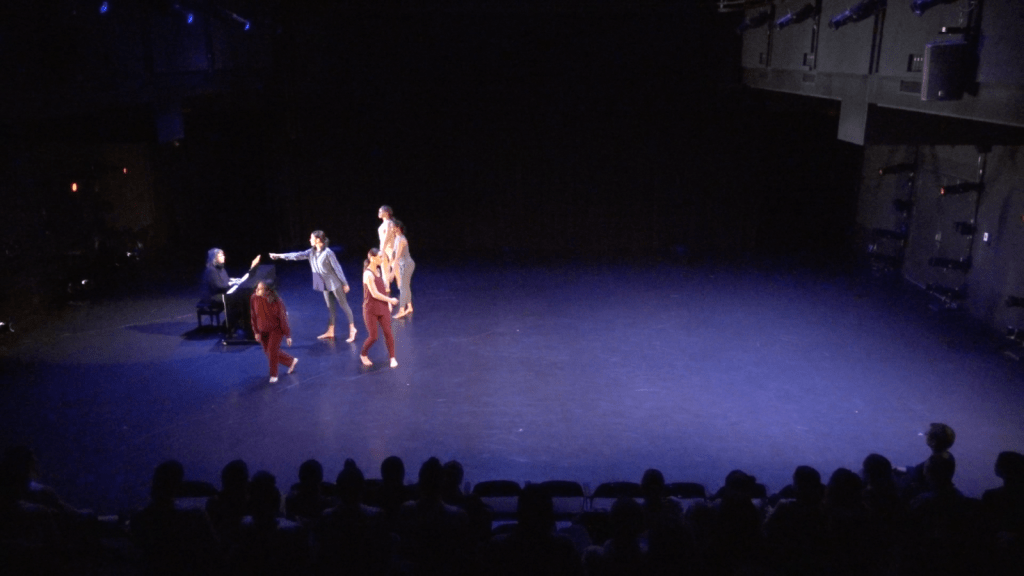
Interconnect: Performance

Title: Interconnect

Direction and Choreography: Kara Komarnitsky

Performance and Movement Generation: Sydney Lettau, Allison Smith, Vivian Corey, Madeline Denman, Heather Lyu, Rosely Polanco, Ava Raczkowski, Emma Carver

Music: Michael Wall, Seth Alexander, Hotel Neon

Advisors: Norah Zuniga-Shaw, Alex Oliszewski

Lighting Design: Oded Huberman

Production Support: Katie O’Loughlin

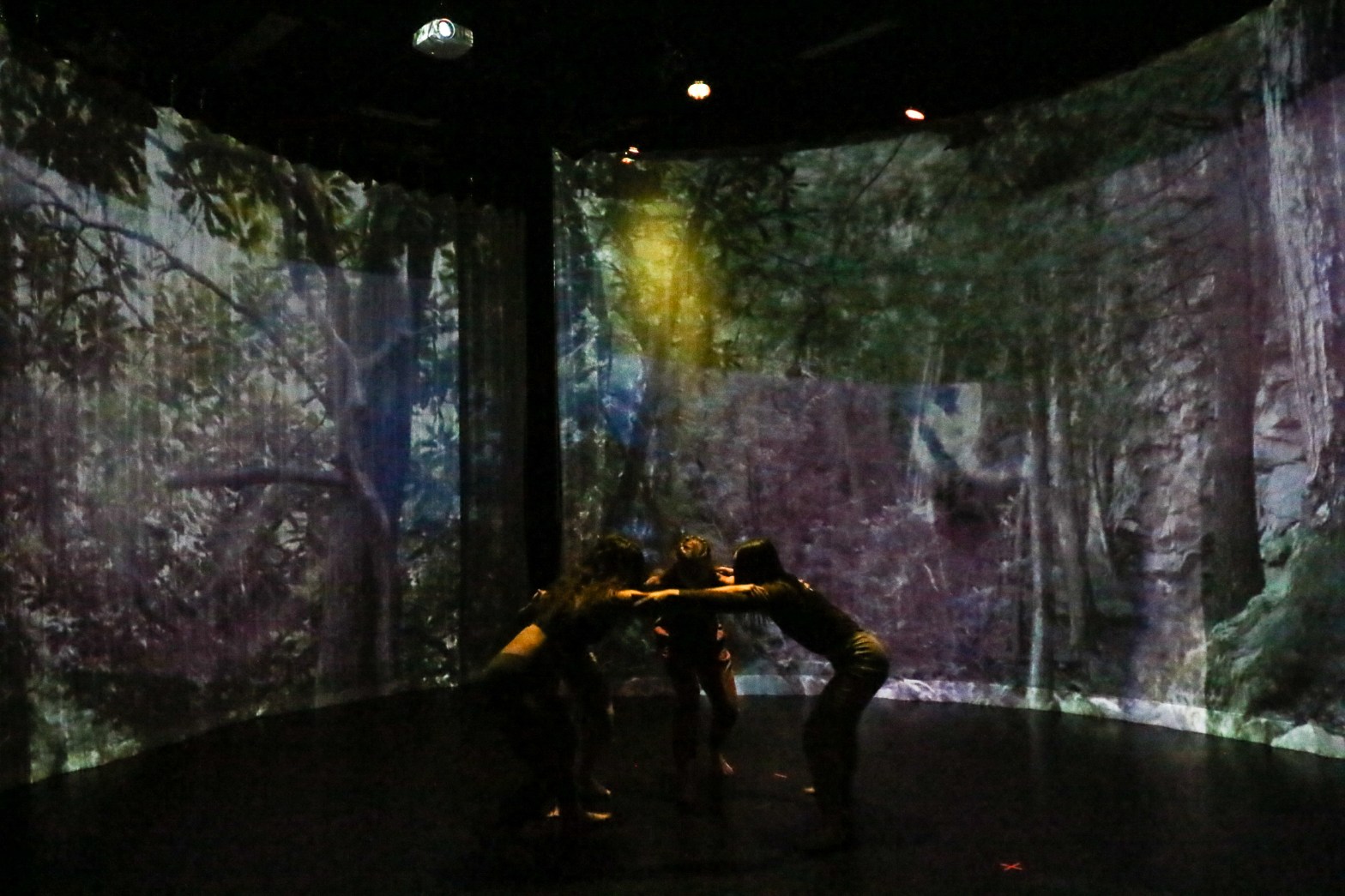
Note: This performance will guide you through three ecosystems, following the pathway that water flows from the mountains into the ocean. The text that you hear will invite you to move around the space and find different perspectives from which to experience these ecosystems, and yourself within them. The boundaries between our bodies and our environment are more permeable than we imagine.

Acknowledgements

I have to first thank my parents for supporting my college endeavors and always believing in what I wanted to create, even if they didn’t understand it.

I want to thank my primary advisor, Norah Zuniga-Shaw for helping me break out of my comfort zone and giving me language for recognizing the unknown. Thank you for guiding me through the longest process I have ever engaged in and providing the space I needed to let go of things that were holding me back. My secondary advisor, Alex Oliszewski, was a fantastic resource on audience interaction and technology. Oded Huberman spent hours with me in the Motion Lab problem solving Isadora and without him there would be no projections or cameras or music. Thank you, Oded, for always saying “yes” to my crazy ideas and putting in the hours to figure them out. I want to thank Katie O’Loughlin for always letting me bounce ideas off of her and giving me space to work out my thoughts before entering the space. Lastly, I want to thank my dancers for their time and honest engagement with this work. Their creativity and commitment to the ideas that I offered them built the movement for this entire piece and gave it the heart that it deserved.

I have to thank the College of Arts and Sciences Undergraduate Research Scholarship for providing the funding that made this project possible.

I also want to acknowledge the Indigenous tribes that historically stewarded the land that we visited and created the dance on. These include the Seminole, Tequesta, Miccosukee, Cherokee, Tutelo, Erie, Hopewell, Shawnee, Myaamia, Kaskaskia, Yuchi, and Moneton tribes. Their historical and contemporary relationships with the land is vital to recognize as we move forward. Whatever ethos we create to realign our relationship with the environment must center their voices if it is to succeed.

Interconnect: Process

Embodied Interconnection: Intermedia Performance as Environmental Advocacy

The seed of this process started in 2017 with the creation of Tales of the Deep: the first time that I explored an environmental theme with my choreography that connected to my own philosophical perspective on our relationship to the natural world. I revisited this idea with Marshland in 2019, this time experimenting with improvisational responses to videos of the ecosystem in order to develop the material. In 2020, I approached yet another ecosystem with WASTELAND that emphasized a message of harm and change. Each of these projects felt just a little unfinished and my thesis provided space to revisit these with new perspective and interconnect them in a way that tied together my interests in environmental relationships, dance, and intermedia.

As I entered this process I was influenced by the writings of Adrienne Marie Brown, Lucy Lippard, Jane Bennett, William Cronon, Terry Tempest Williams, Richard White, Jennifer Monson, Jeffrey Ellis, Octavia Butler, James Proctor, Robin Wall Kimmerer, Giovanna Di Chiro, and Robert Harrison. I arrived at a few key ideas to guide the process:

  • All bodies will respond to the environment around them differently and I am more interested in how my dancers’ bodies respond than in making them try to match how my body responds.
  • I want to speak for something rather than against.
  • I am interested in what it looks like to embrace our relationship to nature in all of its complexity and oppose the assumed dichotomy between natural and human spaces.
  • I am interested in facilitation that embraces the creativity of matter and explores the relationship between the material of our bodies and those surrounding us.
  • I am interested in taking things slowly and digging deeply, taking notice of what is in the space and prioritizing that experience over the outcome.
  • All boundaries are permeable.

My previous projects approached three different ecosystems: coral reefs, wetlands, and temperate rainforests. I was drawn to each of these for different reasons. In middle school I was exposed to marine biology through summer camps and science fair projects that stoked my curiosity for the small and vulnerable organisms that held up the complex food webs of the oceans. When I moved to Ohio for college I lived close to the Olentangy River and spent hours watching frogs, ducks, and herons move through the riparian ecosystems that were such a vital part of the midwestern watershed and yet also some of the most highly damaged ecosystems in the country due to human impacts. Through my engagement with the Sierra Student Coalition during college I traveled to West Virginia to organize against mountaintop removal and got to experience firsthand the dichotomies in place within one of the richest ecological systems in our country but poorest human population.

As I began to interweave my thoughts about these ecosystems into one narrative it required some research into the ecological functions that they each fulfill. I discovered connected migration patterns, waterways, and uses. I kept being brought back to the question of “Where are the edges?” and realizing that there is no simple answer for these ecosystems any more than there is a simple answer for our bodies. I also discovered many long-standing problems that have been caused by human interaction with these ecosystems but that are more complicated than just ignorance or greed. I wondered what it would look like to build a new ethos of relating to these ecosystems and realized that in many ways it would mean a new way of relating to ourselves as well. At the same time I know that it will take us decades to undo damages and rebuild our relationships to each other and the planet. I wanted to focus, not on the seeming impossible journey ahead of us, but the reasons that we choose to embark upon it, the awe and wonder and presence that we gain when we realize our interconnection to the planet.

Two main questions arose that I wanted to explore with the project:

1) How can movement help increase individual and group awareness of the human body’s physical interconnectedness with the environment?

2) How can intermedia performance impact the audience’s perception of human relationships with the environment?

In order to investigate how our bodies respond and relate to each of these ecosystems, a vital part of the process was traveling to them and taking 4-5 hours for embodied research with each one. Using the key ideas I had developed over the summer of research and leaning on/adjusting the scores provided in A Field Guide to iLANDing by Jennifer Monson and others, I created a series of scores tailored to each ecosystem to help us explore our relationships with them. I prepared the dancers for the ecosystem with some information about it for them to read before our visit and have some context for the experience however, the main goal was to collect in the moment responses.

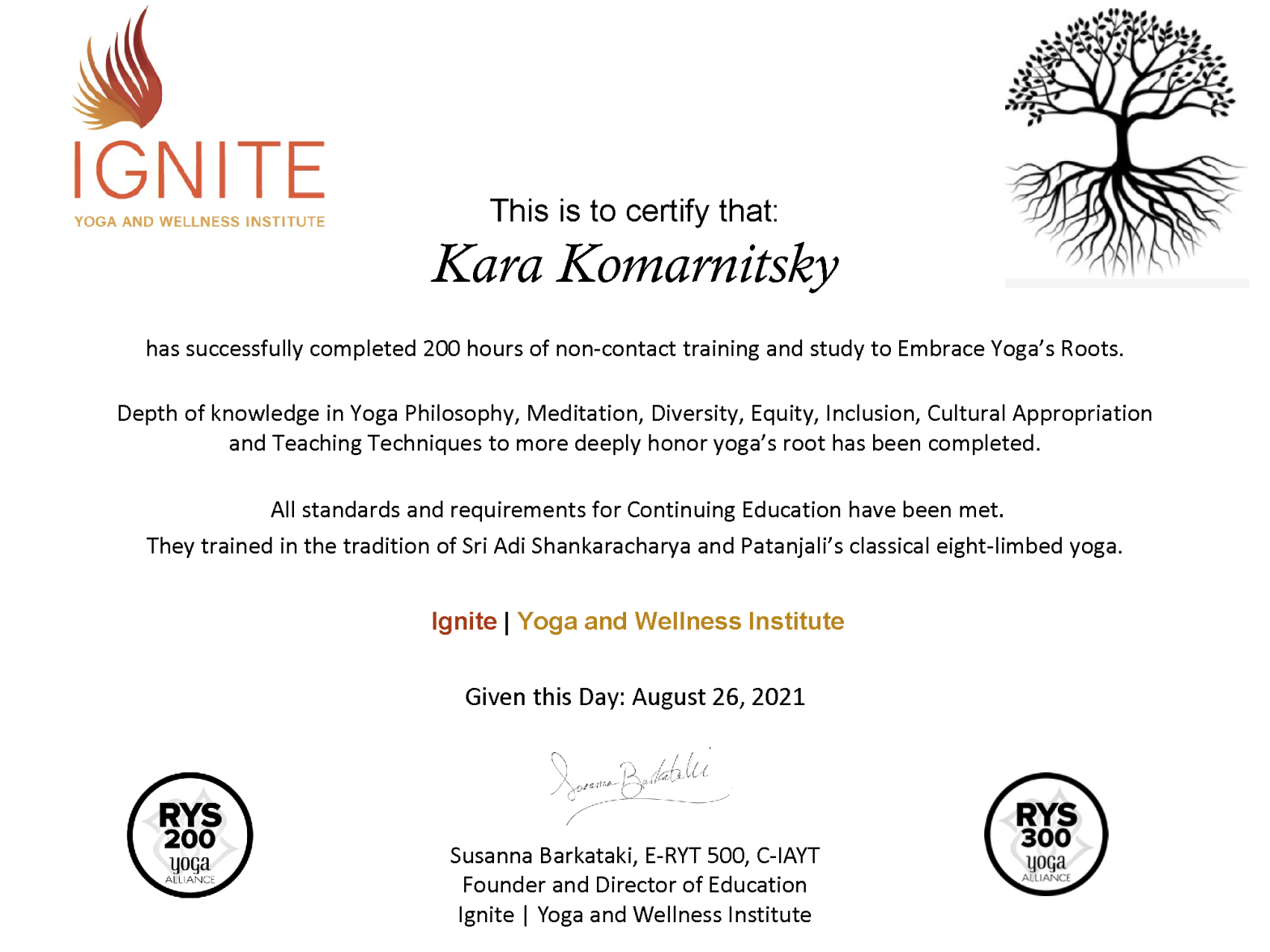
Embracing Yoga’s Roots Course

This summer I was able to participate in Susanna Barkataki’s Embracing Yoga’s Roots Course. It is an extra, in-depth course for Yoga teachers to learn about the historical and spiritual roots of Yoga and teach classes that more authentically represent all aspects of the practice. I wanted to take this course in order to decolonize my own practice and ensure that I was not contributing to the appropriation of Yoga in my teaching.

While my initial plan was to complete the Embracing Yoga’s Roots Course during the month of May, it ended up taking me the whole summer because of the depth of information that was included. There were four modules of specific course materials but a wealth of bonus content that I found really useful to dig into. Ultimately it was a summer full of deep practice and learning that I am so grateful to have had the opportunity to experience.

One thing that the course emphasized was that in order to teach a more honoring Yoga class, you must also have a deeper and more honoring Yoga practice. It introduced me to people, practices, and ideas that allowed me to explore my own Yoga practice deeper and use that to inform my teaching. While the course did explain how colonialism and cultural appropriation has impacted Yoga in the West, Susanna also encouraged all of us to use our own critical thinking for each situation that felt wrong to us and really develop our own sense of what is appropriate with the information she gave. She emphasized at all times that Yoga and antiracist work are similar in that there is no checklist that you can complete and say that you are done. Perfection is often not attainable nor does right action have to look exactly the same for everyone. I was pushed creatively in a lot of ways when designing my own Yoga class to avoid falling back on the appropriative ways of teaching that have become ingrained in Western Yoga classes, and instead to create something new that felt truer to my practice of Yoga. As my final project, I developed a Yoga class that includes pranayama (breathwork), dhyana (meditation), dharana (mindfulness), sankalpa (intention), yamas and niyamas (Yoga ethics), and asana (movement). I learned how to incorporate a land acknowledgement and a spiritual lineage acknowledgement in the opening of the class to ground my future students in the history of our space and practice. I also developed a plan for contributing to reparations toward the South Asian lineage that Yoga comes from, which is also part of the Yoga practice of asteya (generosity, non-stealing).

At the end of this training, I feel that my voice as a teacher has become more clarified just as my practice of Yoga has become clarified. I also feel like this was just the start of my journey. I still have access to the community that was taking the course and so many contacts and connections from the last couple of months that will help me continue this work beyond the course. My awareness and practice of Yoga has expanded to every aspect of my life and become a clarifying perspective from which to address complexity.

evolve

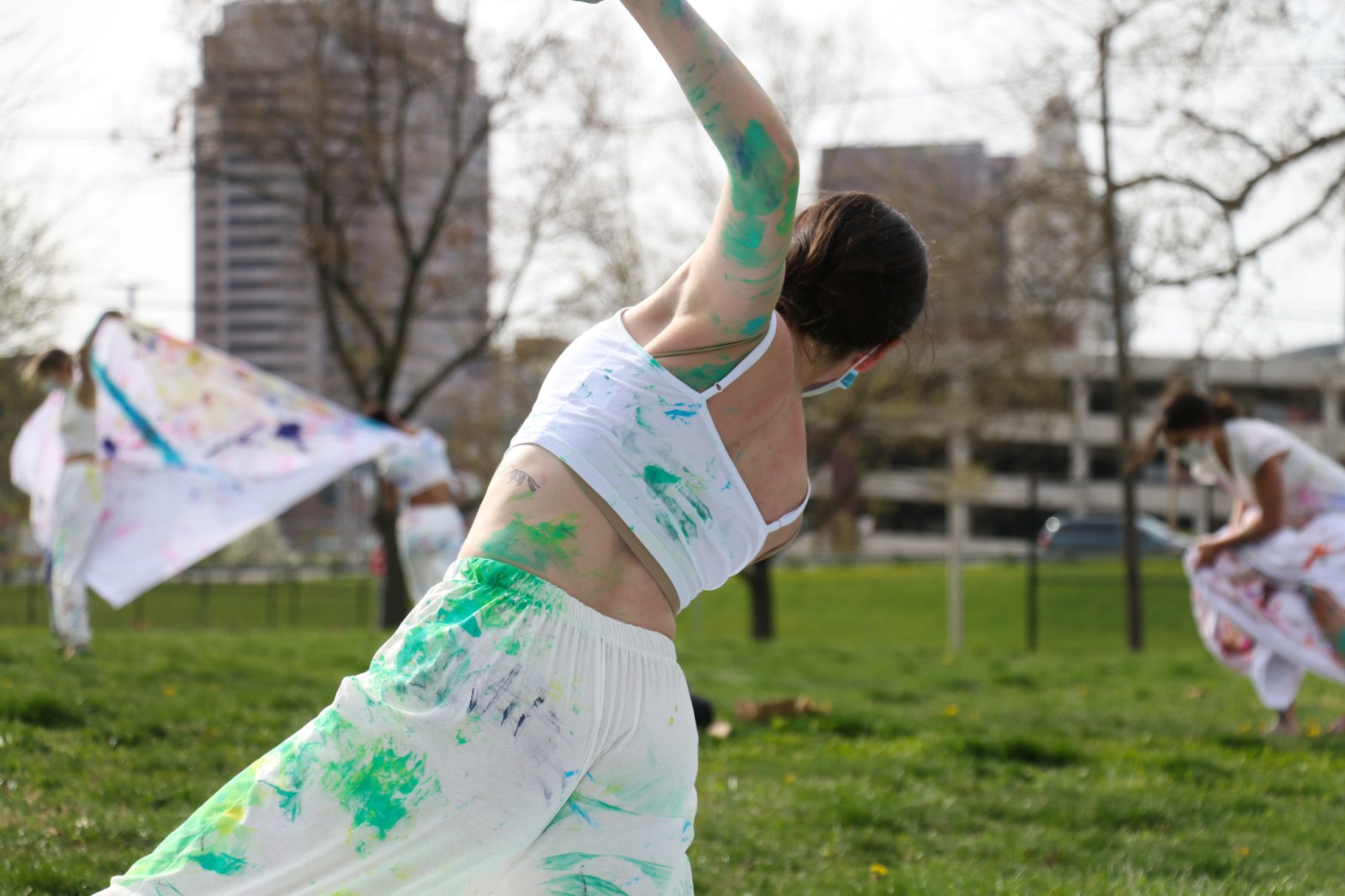
I had the pleasure of being in Angela Pujolas’ senior project this past semester. We worked on several group improvisation scores and explored how associations of color and feeling impacted our movement choices. It was a beautiful experience to persevere through the Covid restrictions with so many amazing artists, and the resulting performance was the first time in a long time that I was able to touch other dancers in a piece. It was really amazing for those of us dancing and for those witnessing.