Intermedia Development
Engaging with the Motion Lab was a big goal of mine for this project in order to break the standard performer-audience separation and integrate a larger environment with the movement. This connected to an idea that I had been playing with throughout the process of how the skin is a permeable boundary and the separation between body and environment really is not so clear. I was originally thinking about this as almost an installation environment that the audience would be able to interact with physically and change the projections and light however, a lot of this vision changed as I brought the dancers into the space and tried new things out.
I realized very quickly that I could not work on the dance separately from the Motion Lab, as my original plan intended. Having people in the space changed my ideas about it dramatically and having the space around the movement influenced it as well. My advisor, Norah, really helped me see the wide range of possibilities of the space and question my role in the process. I realized that I had a lot of assumptions and fears in the space with me that I hadn’t intended to bring along that were impacting my ability to create. This intermedia-creation space was somewhere that I had never been before, artistically, and I was holding onto familiar ideas about performance and choreography because I was afraid of going too far outside of my comfort zone but, ultimately, this was holding me back. I had to confront a lot of internal assumptions about what makes me an artist, who I wanted to be as an artist, what I take ownership of in the process and what I don’t; I had to decide what I really cared about and why I wanted to use the space; I had to confront my own fears of validity and wholeness; I realized that my personal growth is not separate from my artistic growth.
Once I brought my dancers into the space, we started trying out everything that came to mind. I said “yes” to everything as a way of exploring the capabilities of the space and intentionally pushing myself past my comfort zone, embracing the fear and uncertainty of that place with a sense of play. I started involving text that I read aloud throughout the dance. We connected to cameras in the ceiling to the projections with filters and effects that related to the ecosystem being projected. I let go of trying to “recreate” the environment that we had visited and thought more about “re-engaging” with it. I spent hours editing location footage from a 360-degree camera so that it would be able to send to three projectors and blend into an immersive view of where we went, and I didn’t end up using any of it. I used a depth sensor to create a mosaic of glowing dots that followed people through the space that I called “fireflies.” I started letting the movement speak to the space and finding places where the two could relate and interconnect.
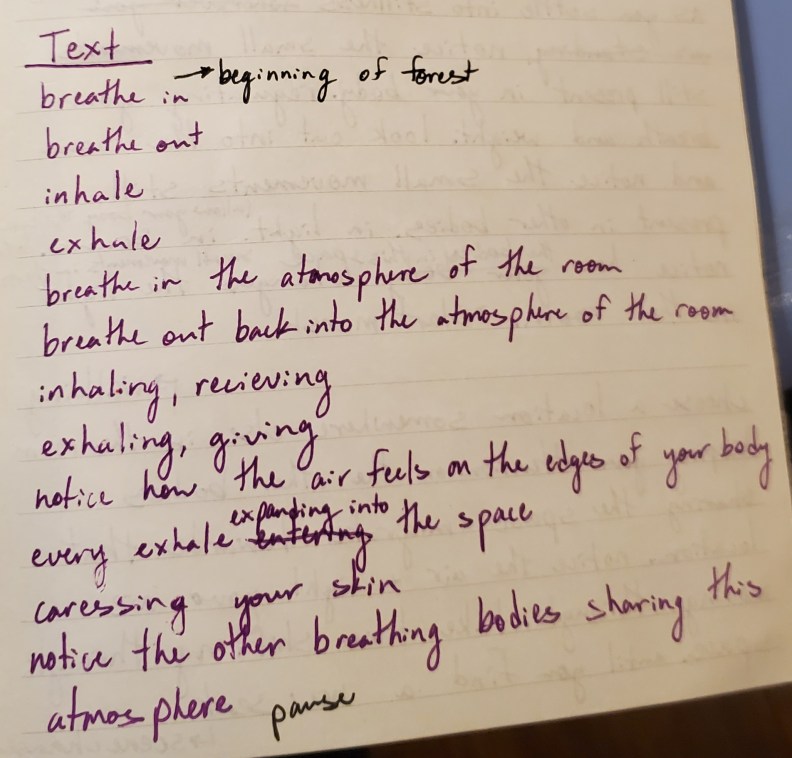
Version 1 of the text spoken during the piece. 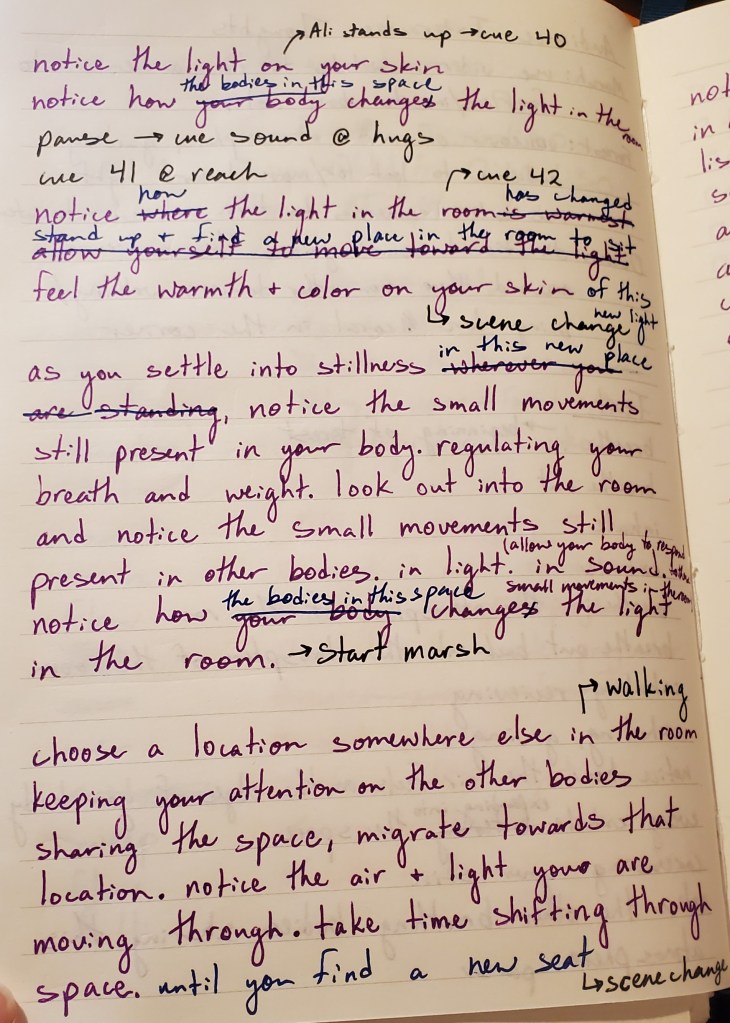
Version 1 of the text spoken during the piece. 
Version 1 of the text spoken during the piece. 
Version 2 of the text spoken during the piece. 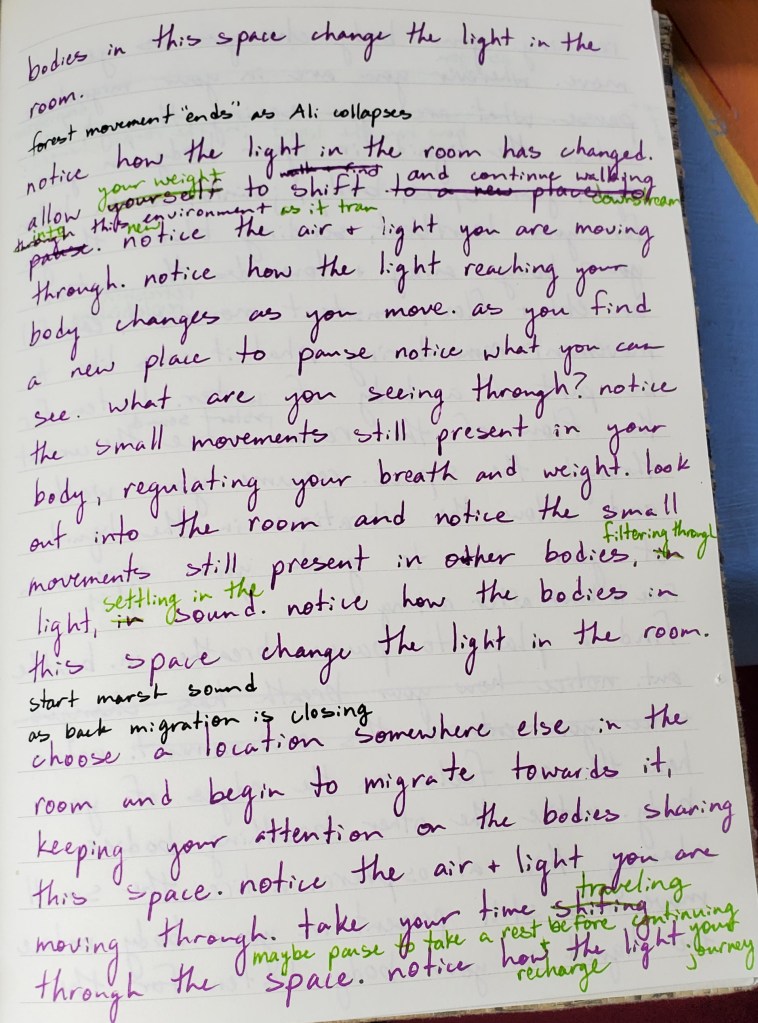
Version 2 of the text spoken during the piece. 
Version 2 of the text spoken during the piece. 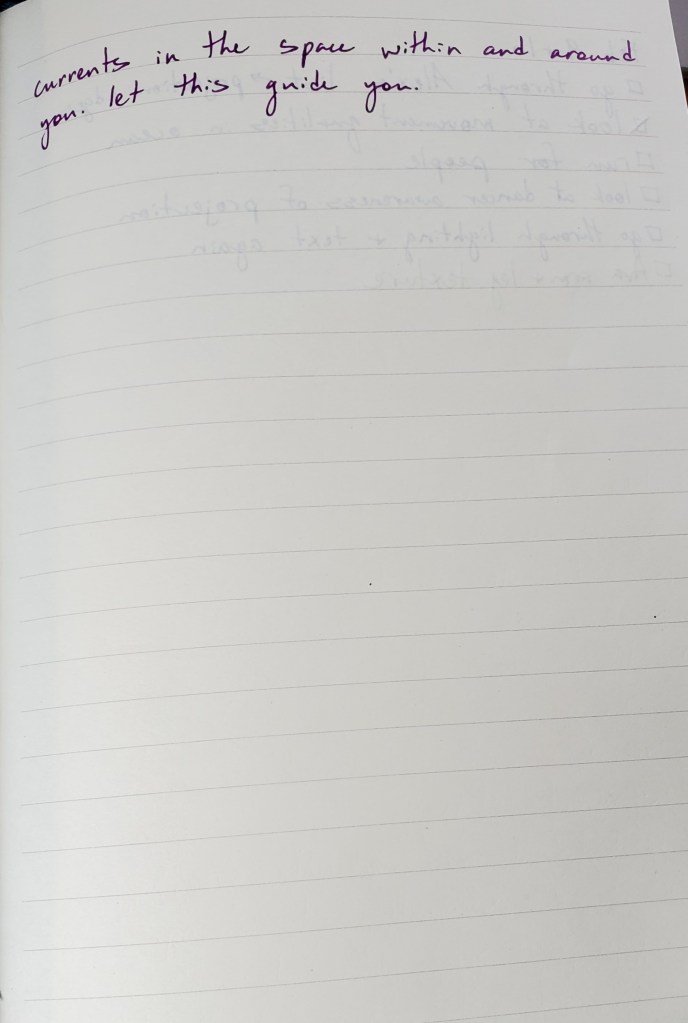
Version 2 of the text spoken during the piece.
The text I spoke started to become a really integral part of the work and was the last thing to clarify (see above for the development of the text). My original intention was for it to engage the audience to move through the space, perhaps in a “workshop” sort of function to help them interact with the space. However, the more things got layered into the work the more chaotic it felt and, with some helpful feedback from my advisors, I decided to intentionally make it more of a guided performance. This aligned with my desire to facilitate the way the audience sees the work and focus on the things that I loved about the movement my dancers and I had created together. I also came to feel that this performance was a sense of closure for the years of thought, improvisation, and work that have fed into this project. Ultimately the text was a combination of the improvisation scores that we used during the site visits and language directing the audience how to see and move with the work. It brought together the many elements of the piece into a narrative that the audience could follow through the space to whatever level they were comfortable with.
It was really exciting for me to bring an audience into this because they changed the space so much. The dancers wove through them and created new pathways every night. The movement of bodies created new shadows and patterns of light in the projections. As I watched the audience move I would adjust my language and timing to their flow. What really gets me excited is that every person got a different experience and as I talked to people after the show, some things aligned with what I imagined people would get but some things were totally new and wonderful! I realized that this work had become emergent itself, just like the ecosystems that we had created it from and that the whole picture of what it “is” isn’t whole without the collective experiences of everyone involved and even then it is greater than the sum of its parts.
 Kara Komarnitsky