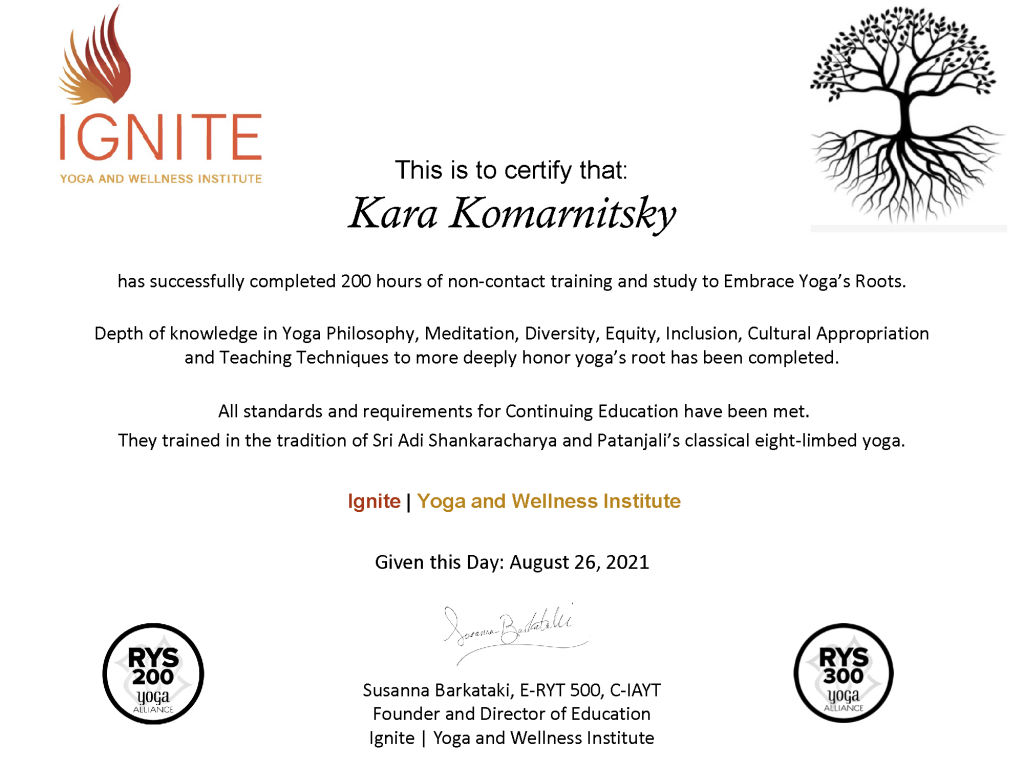
This summer I was able to participate in Susanna Barkataki’s Embracing Yoga’s Roots Course. It is an extra, in-depth course for Yoga teachers to learn about the historical and spiritual roots of Yoga and teach classes that more authentically represent all aspects of the practice. I wanted to take this course in order to decolonize my own practice and ensure that I was not contributing to the appropriation of Yoga in my teaching.
While my initial plan was to complete the Embracing Yoga’s Roots Course during the month of May, it ended up taking me the whole summer because of the depth of information that was included. There were four modules of specific course materials but a wealth of bonus content that I found really useful to dig into. Ultimately it was a summer full of deep practice and learning that I am so grateful to have had the opportunity to experience.
One thing that the course emphasized was that in order to teach a more honoring Yoga class, you must also have a deeper and more honoring Yoga practice. It introduced me to people, practices, and ideas that allowed me to explore my own Yoga practice deeper and use that to inform my teaching. While the course did explain how colonialism and cultural appropriation has impacted Yoga in the West, Susanna also encouraged all of us to use our own critical thinking for each situation that felt wrong to us and really develop our own sense of what is appropriate with the information she gave. She emphasized at all times that Yoga and antiracist work are similar in that there is no checklist that you can complete and say that you are done. Perfection is often not attainable nor does right action have to look exactly the same for everyone. I was pushed creatively in a lot of ways when designing my own Yoga class to avoid falling back on the appropriative ways of teaching that have become ingrained in Western Yoga classes, and instead to create something new that felt truer to my practice of Yoga. As my final project, I developed a Yoga class that includes pranayama (breathwork), dhyana (meditation), dharana (mindfulness), sankalpa (intention), yamas and niyamas (Yoga ethics), and asana (movement). I learned how to incorporate a land acknowledgement and a spiritual lineage acknowledgement in the opening of the class to ground my future students in the history of our space and practice. I also developed a plan for contributing to reparations toward the South Asian lineage that Yoga comes from, which is also part of the Yoga practice of asteya (generosity, non-stealing).
At the end of this training, I feel that my voice as a teacher has become more clarified just as my practice of Yoga has become clarified. I also feel like this was just the start of my journey. I still have access to the community that was taking the course and so many contacts and connections from the last couple of months that will help me continue this work beyond the course. My awareness and practice of Yoga has expanded to every aspect of my life and become a clarifying perspective from which to address complexity.
 Kara Komarnitsky